

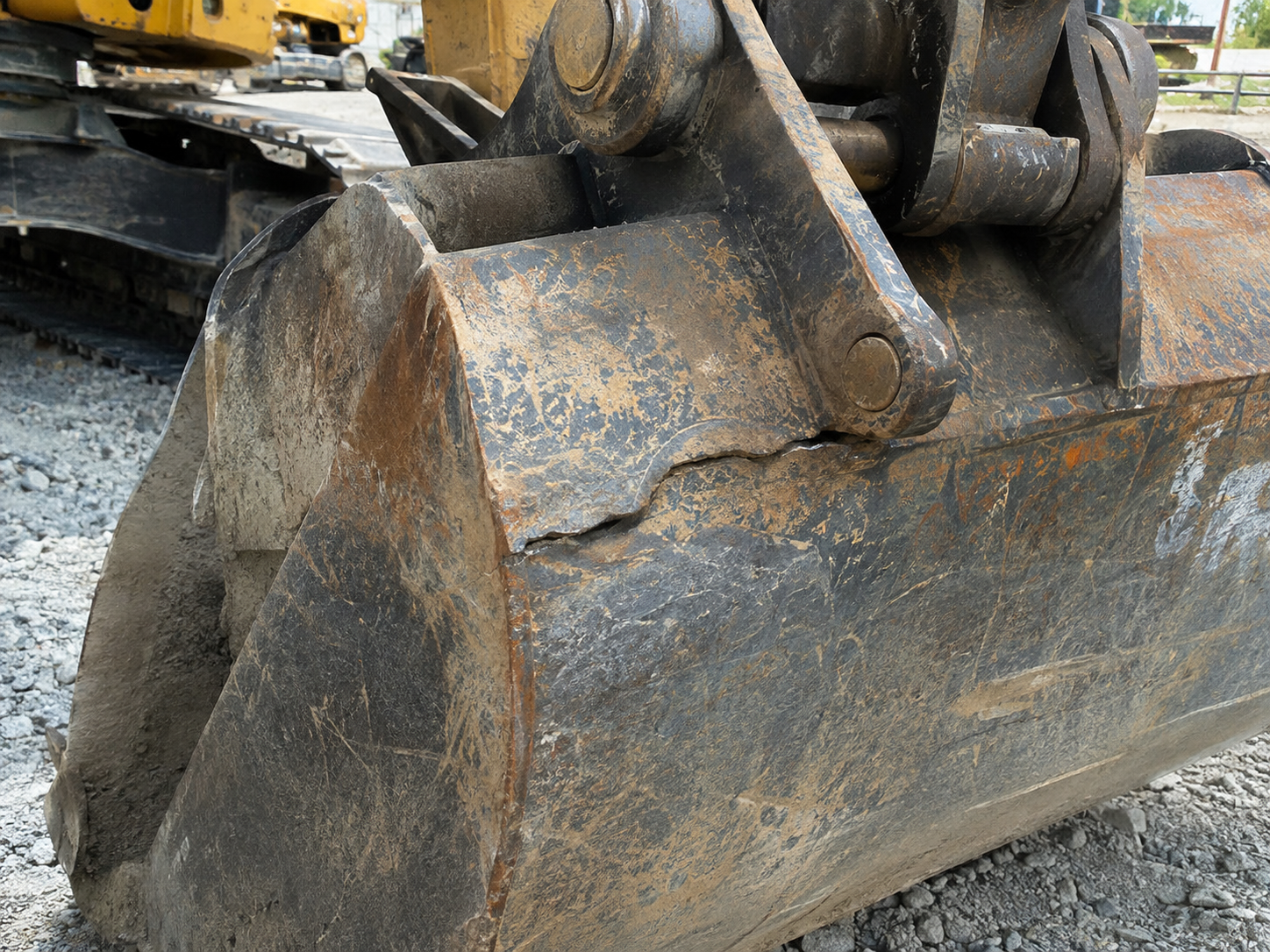
Yes, in most cases. A cracked excavator boom can be welded on site if the crack is found early, the steel around it is sound and the boom isn’t bent. A proper repair finds the full crack, gouges it out to clean metal, preheats the steel and rebuilds it with low-hydrogen weld. Proud Mobile Welding makes these repairs on job sites across the Austin area, 24/7.
Key Takeaways
- Stop digging as soon as you see a crack in the boom. Boom cracks grow with every load.
- Most boom cracks can be repaired on site, without hauling the machine to a shop.
- A lasting boom repair takes crack testing, full removal of the crack, preheat and low-hydrogen filler metal. A bead over the top will fail.
- Reinforcement plates help only when they’re shaped and placed correctly. A badly placed plate creates a new crack.
- A bent boom, cracks through several plates or a crack that keeps coming back usually means repair isn’t the right call.
Is It Safe to Keep Running an Excavator With a Cracked Boom?
No. A boom crack grows with every bucket of dirt, and a boom that fails under load can drop the stick and bucket without warning.
If you or your operator spot a crack during a walkaround or while greasing, lower the bucket to the ground, shut the machine off and keep people out from under the boom. A small crack caught today is a repair. The same crack run for another week can mean a new boom.
Where Do Excavator Booms Crack Most Often?
Booms crack where loads concentrate: at the boom foot, around cylinder mounting brackets, at the boom-to-stick pivot, and along the welded seams of the box section.
- Boom foot: the base of the boom where it pins to the machine. It carries the whole load of every dig.
- Cylinder brackets: the lugs where the boom and stick cylinders attach. Cracks often start at the edge of the bracket weld.
- Boom nose: where the stick pins to the boom.
- Box-section seams: a boom is a hollow box made of welded steel plates, and cracks can run along those seams.
- Old repairs: a past weld made without preheat, or with a reinforcement plate cut square, is a common starting point.
Austin ground adds to it. Prying through limestone and caliche west of I-35 twists the boom hard. Heavy, sticky blackland clay east of I-35 loads it up on every pass.
How Is a Cracked Boom Welded So It Holds?
We find the whole crack, remove it completely and rebuild the steel with controlled heat. Every step matters, because booms are made of high-strength steel that cracks again if it’s welded wrong.
- Make it safe. The bucket goes to the ground, the machine is shut off, hydraulic pressure is relieved and the keys come out. We follow the machine maker’s guidance on disconnecting the battery to protect the electronics.
- Find the full crack. We clean the area to bare metal and use crack testing to find exactly where the crack ends. One method is dye penetrant, a spray that makes fine cracks show up as bright lines.
- Drill stop holes. A stop hole is a small hole drilled just past each end of the crack so it can’t keep running.
- Gouge it out. We remove the crack all the way through with air carbon arc gouging, which uses an electric arc and compressed air to cut metal away, then grind the groove clean.
- Preheat. Preheating means warming the steel before welding so it cools slowly and doesn’t crack. The temperature depends on the steel and its thickness, and we check it with temperature-indicating crayons.
- Weld it back up. We use low-hydrogen filler metal, which keeps hydrogen out of the weld and prevents hidden cracking in high-strength steel. The groove is filled in multiple passes, with the heat kept in range between passes.
- Finish and reinforce if needed. We grind the weld smooth so there are no sharp edges for a new crack to start from. If the area needs reinforcement, we add a plate with tapered ends rather than square corners, so load spreads out instead of piling up at one spot.
We keep our ground lead right next to the weld so welding current stays away from pins, bushings and cylinders. We also shield nearby hydraulic hoses from heat and spatter. Our heavy equipment repairs follow the principles of AWS D14.3, the American Welding Society’s standard for welding earthmoving and construction equipment.
Should You Weld the Boom or Replace It?
Weld it when the crack is in one area and the boom is straight. Replace it, or call the dealer, when the damage goes beyond one crack.
| What you’re seeing | Weld on site? | Replace or send to the dealer? |
|---|---|---|
| Single crack in a plate or seam | Usually yes | Rarely needed |
| Crack at the edge of a cylinder bracket weld | Usually yes | If the bracket itself is torn out |
| Crack that came back after an earlier repair | Sometimes, with the cause fixed | If it keeps coming back |
| Cracks through several plates | Rarely | Usually |
| Boom bent or twisted | No | Yes |
| Worn-out (oval) pin bores | Needs line boring, a machining job | Sometimes |
If the machine is a rental, call the rental company before anyone welds on it. Many rental contracts say who’s allowed to repair their equipment.
What Happens When You Call Us About a Cracked Boom?
You get a welder on the phone, a plan, and a price before any work starts. The welder who quotes the job is the welder who does it.
- Call (512) 810-4365. Tell us the machine’s make and model, where the crack is and where your job site is. Text photos if you can.
- Get a straight answer. From the photos, we’ll tell you if it sounds like an on-site repair and give you an honest arrival time.
- We inspect it. We test for the full length of the crack and check the steel and the boom for distortion.
- You get a firm price. You know the cost before we start.
- We repair it on site. The machine stays where it is.
- Walk-around. We show you the repair and what to keep an eye on.
How Much Does a Boom Repair Cost and How Long Does It Take?
It depends on the crack, the steel and the access. A short crack in an easy spot is a much smaller job than a crack at the boom foot that needs reinforcement.
- Length and depth of the crack, and how thick the steel is
- Where the crack is and how easy it is to reach
- Whether reinforcement plates are needed
- Whether it’s a night, weekend or holiday call
We give you a firm price after we’ve seen the boom, so you can weigh it against what a new boom and a week of downtime would cost.
When Should You Call a Welder Right Away?
Call as soon as you see any of these warning signs:
- A visible crack anywhere on the boom, even a short one
- Paint cracking or flaking in a line, which often marks a crack underneath
- Rust stains bleeding out of a seam
- A crack at the edge of a cylinder bracket or near a pin
- New noises, flex or movement in the boom under load
While you wait, keep the bucket on the ground, move fuel cans and dry grass away from the machine, and keep the crew clear. Welding throws sparks.
Frequently Asked Questions
Can a cracked excavator boom be welded on site in Austin?
Yes. Proud Mobile Welding repairs cracked excavator booms on job sites across Austin, Round Rock, Georgetown, Cedar Park, Leander, Pflugerville, Hutto, Manor, Kyle, Buda, San Marcos and Dripping Springs. We bring the welding, gouging and preheat equipment to the machine.
Is a welded boom as strong as the original?
A boom crack repaired correctly can be as strong as the steel around it. That means testing for the full crack, gouging it out, preheating and welding with low-hydrogen filler metal. A bead laid over a crack is not as strong. If a boom is bent or cracked in several places, we’ll tell you it needs replacing.
What causes excavator boom cracks?
Most boom cracks come from repeated heavy loading over time, called metal fatigue, plus prying, twisting and hard digging in rock. Old repairs made without preheat or with square-cornered plates are another common cause.
Should I add a plate over a boom crack?
Not by itself. The crack has to be removed and welded first. A reinforcement plate can help afterward, but only if it has tapered ends and is placed so it spreads load. A square plate welded over a crack often starts a new crack at its corners.
Can you weld on a rented excavator?
Call the rental company first. Many rental agreements require their approval or their own service team for repairs. If they approve it, we can make the repair on site.
Do you repair booms on nights and weekends?
Yes. Our emergency welding service runs 24/7. Call (512) 810-4365 and we’ll give you an honest arrival time.
Cracked Boom on Your Job Site?
Don’t keep digging, and don’t call a lowboy yet. Our on-site heavy equipment welding and repair fixes boom cracks right where the machine sits, and our 24/7 emergency welding means you’re not waiting until Monday.
Proud Mobile Welding, LLC is insured and bonded. Call (512) 810-4365 or request a quote at www.proudmobilewelding.com.
